
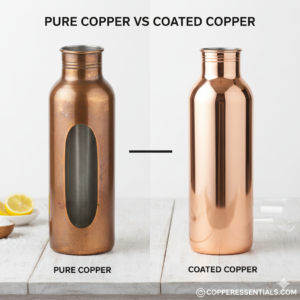
 When shopping for a copper water bottle, you will likely encounter two main types: pure, raw copper and coated (lacquer-lined) copper. While they might look similar on the shelf, the way they interact with your water—and your health—is vastly different.
At Copper Essentials, we believe in transparency. If you are investing in a copper vessel for its wellness benefits, understanding the difference between “pure” and “coated” is essential.
Here is everything you need to know to make the right choice for your hydration ritual.
What is a Coated Copper Bottle?
Many mass-produced copper bottles are coated with a thin layer of food-grade lacquer or resin on the inside. Manufacturers do this for one primary reason: to prevent tarnishing.
Copper naturally reacts with air and water (oxidation), which causes it to darken or develop a patina over time. A coated bottle stays shiny and bright forever without the need for cleaning with lemon or salt. However, this convenience comes at a significant cost to the bottle’s functionality.
What is a Pure Copper Bottle?
A pure copper bottle is exactly what it sounds like—unadulterated, raw copper on both the inside and outside. At Copper Essentials, our bottles are handcrafted from high-quality, lead-free copper. Because there is no barrier between the water and the metal, the water can actually interact with the copper.
The Comparison: Which One Wins?
1. The Health Benefits (The “Oligodynamic” Effect)
- Pure Copper: The primary reason to use a copper bottle is the oligodynamic effect—the process where copper ions dissolve into the water to kill bacteria and provide antioxidant benefits. In a pure copper bottle, this process happens naturally.
- Coated Copper: Because the lacquer acts as a plastic-like barrier, the water never actually touches the copper. A coated copper bottle provides zero Ayurvedic health benefits. It is essentially a metal bottle with a plastic lining.
- Winner: Pure Copper
2. Maintenance and Cleaning
- Pure Copper: Requires regular cleaning (usually once a week) with natural acids like lemon and salt to remove oxidation and maintain the ionization process.
- Coated Copper: Maintenance-free. It stays shiny with just a quick rinse of soap and water.
- Winner: Coated Copper (for convenience only)
3. Longevity and Safety
- Pure Copper: Copper is a timeless material. Even if it tarnishes, it can always be restored to its original glow. It is a lifetime investment.
- Coated Copper: Over time, the internal chemical coating can chip, crack, or peel due to temperature changes or wear. This means you could potentially ingest small flakes of lacquer with your water.
- Winner: Pure Copper
How to Tell the Difference
If you aren’t sure if a bottle is pure or coated, try these three tests:
- The Shine Test: If the inside of the bottle is as reflective and mirror-like as the outside, it is likely coated. Raw copper has a more matte, subtle texture on the interior.
- The Aging Test: If you have used the bottle for a week and the interior hasn’t changed color at all, it is definitely coated.
- The Wipe Test: Pure copper will often leave a very faint, characteristic metallic scent on your hands or a cloth. Coated copper smells like nothing.
The Verdict: Pure is the Only Way
If you are buying a copper bottle for its aesthetic beauty alone, a coated bottle might suffice. However, if you are looking to embrace the ancient practice of Tamra Jal—to aid digestion, boost immunity, and balance your doshas—pure copper is the only choice.
At Copper Essentials, we never compromise. Our bottles are 100% pure, uncoated copper, ensuring that every sip you take is charged with the natural power of the metal.
Experience the difference of authentic wellness. Shop our collection of Pure, Handcrafted Copper Bottles here.